Showing posts with label education. Show all posts

Saturday, April 20, 2019

ClassTag Rewards: Perks for Parent Communication

I use ClassTag to manage parent communication with my before and after school ensemble families. One of the big benefits of ClassTag is that parents can get alerts via text, email, and/or in-app notification according to their preferences. As a teacher of a ClassTag class, you're able to opt in to ClassTag Rewards, a great program allowing you to earn classroom goodies just for using ClassTag to communicate with families. Here's a sample of the ClassTag Rewards page for one of my classes:

There are many other rewards, so I could not fit them all in one screenshot. My favorite reward available is a $15 Amazon gift card, which currently costs 2,900 ClassTag coins. As you can see, I've earned more than enough coins in this class to redeem for one with this class. The gift card allows me to buy anything I might need for my classroom (or myself) that's available on Amazon, which means there's a lot of flexibility in how I spend the reward.

In addition to the awesome Rewards program, ClassTag also has top-notch customer service. I recently had a problem redeeming a reward (my school email spam filter is a little overreactive sometimes) and their chat feature was so easy to use. The person I spoke to was super helpful and got me a new gift card code ASAP so I could shop right away. It's always nice when a company seems genuinely interested in helping its customers!

Sign up for ClassTag using my code, and you'll get some ClassTag coins to use on rewards to get you started!

--I am a ClassTag ambassador. I receive referral incentives for sharing how I use ClassTag in my teaching, but really do believe in their service and think it's useful for teachers.

Saturday, February 2, 2019

What's the point?

I had an observation a few weeks ago, and due to life happening didn't have a post-conference until this week. It went fine, with the usual questions and recommendations that I always expect from being observed by an administrator who hasn't taught music. But one question stuck out to me: why were students working towards this objective, and how did they know? It's a legitimate question, and something I definitely hadn't made explicit even though I did have a plan for why they were doing this and where they were going with it. It didn't strike me because of my lesson that I taught. It struck me because of my experiences in grad school.

This is week 2 of my last class, I'm finally almost done. But I have no idea why I'm being asked to re-read articles I've written about before in order to put together a summary in this course's preferred format. I have no idea why I'm being treated like a middle schooler with lots incremental deadlines and paper pushing in the capstone of a masters degree. I have no idea why I have to sit through "live classroom" online meetings that say the same thing I have already read in the course content. Literally, the point of every class activity for me so far is to jump through one of the hoops remaining between me and an expensive piece of paper I need for a pay raise and recertification. It's compliance in the worst sense, doing things for the sake of following directions, earning points, and getting through this as quickly and painlessly as possible. I did an assignment last week figuring it was just barely enough to earn an A... and I was right. Sure, I'd learn more if I put more in. But I just can't. There's no point. Beyond finishing this degree, doing the tasks of this class is merely teaching me how to be a compliant point-grubber who formats really well. It's not learning. It's not useful. Another $3000 plus wasted on educational hypocrisy. Only 72 days until I'm done learning how not to teach.

Friday, January 18, 2019

The Beginning and the End

My school district hosted our All-Districts music festival last Friday. Before I made my way over to the high school to help out and observe some master conductors at work with the best and brightest high school musicians in the area, I held a before-school beginning band rehearsal for our first concert. It went well, as I expected it to. The kids have been working hard in their group lessons, practicing at home, and taking risks to help them improve their playing. We're taking on the beginning band classics, Hot Cross Buns and Mary Had A Little Lamb, and playing We Will Rock You for a fun ending that's a bit more relevant to pop culture. Our two "harder" songs have four notes each. This is absolutely normal and developmentally appropriate for beginning band, given our rehearsal schedule and the age of the students.

The All-Districts band I got to watch, on the other hand, was playing dozens of notes. They took on some amazing rep, including Wagner's Elsa's Procession to the Cathedral and a very difficult Persichetti piece. The chorus, orchestra, percussion, and jazz ensemble were likewise grappling with challenging music, pieces which represent significant artistic achievement in their respective musical fields.

It's fascinating to see the differences in these two groups, and the similarities. "Breathe together to play together", a phrase my beginning band students have heard enough to finish for me, doesn't just apply to fifth graders. Students talked and laughed together during breaks, just as my students tend to do. They left instruments in precarious positions, just as my students do.

For many of the All-Districts students, they're at or near the pinnacle of their musical journeys - for some, even near the end - while my fifth graders are just beginning to understand and experience band. It's gratifying to see where they're going musically, that their potential in six or seven years includes more than five notes and making beautiful music together. But it's also helped me to see the beauty in simplicity, in getting students to play simple music really well. So much of the limited district rehearsal time was spent on fundamentals, things that my students are already working on. Playing a scale in tune is hard! It takes years of practice! But it's important, even if it's not immediately gratifying. Good beginnings are so important in music, so that students can excel when they get to All-Districts or just life beyond elementary school band. It's not about Hot Cross Buns, it's about building the skills to go beyond the basics later.


Thursday, December 27, 2018

Take a Break: Scheduled messages during school vacations with ClassTag

I try really hard not to do a ton of work during school breaks. I really need the time to rest, and I want to spend time with my family and friends, not worrying about work I could or should do. However, I also like to encourage students to practice their instruments over breaks, since many of them have more relaxed schedules. With ClassTag, I was able to set up messages to be sent out over break before I left school last week. It's super easy to schedule announcements for any time in the future. After clicking the giant plus sign in the right hand corner and choosing "Announcement", this screen pops up. Fill in the fields, then click "add send time" in order to schedule it for the future.

Scheduled announcements are super handy for many different purposes, and make it easier to maintain work-life balance while communicating with families at a time that works for them. ClassTag's stats let me see how many families read my announcements. I notice that they are more likely to get read if I schedule them to go out during evening hours (likely because many parents aren't working at that time), so adding a send time is an easy way to improve communication with families.

Ready to sign up for ClassTag and level up your home-school communication? Sign up here !

--I am a ClassTag ambassador. I receive ClassTag coins and referral incentives for sharing how I use ClassTag in my teaching, but really do believe in their service and think it's useful for teachers.

I hope all teachers are having a relaxing, enjoyable break!

Monday, December 10, 2018

The Hills and Valleys of December

Teaching in December is:
a. exciting
b. exhausting
c. frustrating
d. all of the above

Today was a long Monday, and last week was one of the toughest weeks of teaching for me ever. Teaching in December is different from the rest of the year. Not worse, exactly, it's fun to see the kids excited and there's lots of cool events happening, but it's tiring. That hundredth time asking kids to quiet down isn't quite as gentle as the first time. The fifth time kids start randomly singing jingle bells in the middle of another song isn't as endearing as the first time. There's so much joy, so much energy, and so much to do in too little time. December is like a microcosm of the school year, with lots of highs and lows and sugar crashes and drinking too much coffee (or is that just me?).

The best moments, though, come at those times of exhaustion and frustration. I've been using the last few minutes of my music classes to work on songs for our December singalong. We do a big all-school pajama day before break, and I like to do a few non-traditional songs that require the kids to learn a bit of choreography and some short tunes. It's fun, no pressure, and gets us all dancing our way into break. And just when I'm about to remind a student about behavior for the tenth time, they'll perk up and join us in snow hands or "shine fingers" (yes, I renamed jazz hands) or some other silly movement. There's magic in all that energy, in having 20 kindergarteners shove peace signs as close to your face as they can from their seat because they're SO EXCITED about a song they're doing with the "big kids".

I'll be spending the next 9 school days looking for those magic moments, and surviving the frustrating times in between. And then I will take a very long, well deserved winter break nap.

Sunday, November 25, 2018

Thankful

This Thanksgiving break, I've been reflecting on the good in my teaching situation. It's very easy to get caught up in the "could be" "should be" mentality, and while there are things that could be improved, I'm really lucky and have a lot to be thankful for:

  • I'm thankful that all students in my school have music taught by a trained music teacher.
  • I'm thankful that my school has a music room (a lot of schools don't), a dedicated space for music making.
  • I'm thankful that I have supportive colleagues I can confide in.
  • I'm thankful that my students have instruments to play, and that they're able to experience a wide variety of high-quality instruments in music class.
  • I'm thankful that grants help me get more instruments for my students and replace those that are worn or damaged.
  • I'm thankful for the enthusiasm of my students.
  • I'm thankful for supportive families who bring students to outside events and rehearsals beyond the school day.
Things aren't perfect in my school or any other, but I'll be going back to school tomorrow filled with gratitude for what my students and I have.

Saturday, November 10, 2018

Managing Huge School Events is a Breeze with ClassTag!

The biggest event of my school year has come and gone! October flew by since it was consumed by preparing for Cantonstock, a big music concert and fundraiser day that my school system puts on. As one of the music teachers, it's my Super Bowl. Getting information to all my students' families is essential to making the event happen. We need students to arrive at different times depending upon what groups they perform with, and need parent volunteers throughout the day to help. In addition, many students are trying to perform around sporting events and other commitments and require more detailed information on timing and logistics. ClassTag makes communicating all of that super easy!

First of all, ClassTag makes it easy to set up multiple classes. This is key for those of us who teach many different groups of students. Here's the list of classes I see in my account:
I'm able to separate out each section of my band, have a group for my Orff ensemble, and share a class that I co-teach with another teacher so we can both send out announcements and communicate with families. This is so much easier than many communication tools - no more email lists, confusing groups, or limit to the number of sections you can set up!

I was able to set up Cantonstock as an event for each of my classes. An event within ClassTag allows all the information regarding any sort of time-bound activity to be kept in one place. In addition to concerts and out-of-school events, I could see this being used to remind parents to return permission forms, or to help families remember days off school or special events like pajama day and field trips. It's really easy to create an event, and the form helps make it easy to remember to add all the details:
 ClassTag can even remind parents of events with weekly emails! It's also easy to schedule announcements about events (I set up everything in early October for an event in early November) in order to save time during those busy weeks while still keeping parents in the loop.

Events are just one feature of ClassTag, but it's a very useful one for sure. If you'd like to sign up and try it yourself, please consider using my link. Thanks for reading!

--I am a ClassTag ambassador. I receive ClassTag coins and referral incentives for sharing how I use ClassTag in my teaching, but really do believe in their service and think it's useful for teachers.

Monday, October 29, 2018

The Bad and the Good

I've written before about being a grad school student while teaching, and some of the challenges and benefits. My fall class was a lot better than my summer classes, and one idea from the class has stuck with me even though I'm done with the class now: music education is not inherently good. It seemed ironic to hear a question about whether music education was good in a music education degree program in which most of us had spent a years in the field and were currently spending $3,500 to take a music education class. But something about the articles we read and the premise of the question makes so much sense: not every educational experience is a good one.

Education as a harmful experience has helped me make sense of so many of my own school experiences, both as a K-12 student and in college and grad school. Not every class helped me learn something (though I wrote a snarky "this class has taught me how not to teach" on more than one course evaluation) useful. Not every class was worth the time and effort I put in. There's a reason some school experiences didn't work for me beyond my flaws as a student, of which there are many.

But so much of education is good. An a-ha moment about a topic students really care about. Bonding over a certain song, whether it's as part of a Red Sox victory celebration or a more serious occasion. Laughing with a class until everyone needs a drink of water. Hugs from students. Working hard on something and improving on it. Having those goosebump musical moments. It's up to teachers to make those good experiences happen more often, to help students learn and have positive school experiences. This isn't to say teachers should aim to be perfect. Or to "save" students. But if we can find something at school for every kid to look forward to every day, maybe things will be a little better. Or maybe, we can look at experiences that are hurtful for a lot of students (cough, standardized testing, cough) and reimagine a better way.

Me, I'll take the bad with the good, and be grateful that it seems the worst of my experiences as a student should be behind me.

Tuesday, October 16, 2018

Beginning Band and the Joy of Starting Again

If you've never heard a first day beginning band class, you should. Also, go hug your friendly neighborhood beginning band teacher. The first week of band is incredible, joyful, and totally exhausting. There's an entire world of things to teach, from how to assemble instruments to how to make a sound to how to get the spit condensation out after playing (gross, but necessary). But there's this spark in the students that makes it all worth it, even when I find myself saying "left hand on top" for the millionth time. They chose to play an instrument, and are so excited to finally get to do it. The first sounds are always full of squeaks, squawks, and whistles. They're often followed by laughter or disgusted-looking faces. But that moment right before they play, that first inhalation as a group... that's where the magic is.

One breath, one momentary collective pause, holds so much potential. They made the choice, honored the commitment and showed up, and now they're headed somewhere. It might be towards our first concert, middle school band, or maybe even a professional musician gig, but nonetheless we're working towards something. They're cooperating, collaborating, and all those other buzzwords. And they're taking a big risk, because after that breath in...

There's a sound. A joyful noise, as a I call it. Something, even if just a whisper of air, comes out of their instrument. But it's a start. Something to work from. The first note of thousands more to come. There's so much beauty in potential, in hope, in moving forward. In learning and improving. Beginning band has so much to teach... especially to this band teacher.

Saturday, September 22, 2018

Another September

I'm three weeks into the school year, and time has flown by. With assemblies, instrument rental night, meetings, and coordination between schools, it seems like I've spent more time at work than not. But things are good, I finally feel like the coming week will be more about teaching than managing logistics.

For me, September is always a complicated month. I love the start of the new school year, a chance to start fresh and improve. It's always refreshing to see students' friendly faces again after a couple months away. But it's also a time of change, and I've never been super excited for change. I'm working with a bunch of new colleagues this year - they're great, but it's different than last year - and some district systems are new. I started taking a new grad class (which seems good so far and can't possibly be worse than the last one) so that's another transition.

But every September ends (cue the Green Day song...) and a new normal starts. I'm more relaxed with my students this year, and they seem more relaxed with me. This is my third year at my current school, so I think part of it is comfortable familiarity. Planning lessons has gotten way faster for me, and I've accepted that I'll always spend a little bit of time grappling with spreadsheets. I'm really grateful to be in a place where for the most part I can focus on teaching my students. I have a budget that gets me what I really need, and supportive supervisors. I don't have to give standardized tests or teach in a substandard space not suitable for human occupancy.  Things are good, even when they aren't great.

And so as another September comes to an end, I'm settling in. It's going to be a great year!

Monday, August 27, 2018

What I Wish I Knew Before I Started Teaching

I'm still a newish teacher (going into my fourth year overall, third in the same district). But I've learned a lot since I started, some of which will never be in a traditional teacher training program. Here's my big takeaways:

No curriculum is perfect. Do what the kids need, not what the book or computer screen says.
My first district used a very overpriced, very scripted curriculum. Frankly, it wasn't very good. And teaching from a script wasn't fun. But I did it, because I didn't know any better and because I was criticized early on for deviating. Students, and groups of students, are all different. It's more important to teach what they need than what any piece of paper or screen states they "should" learn. Don't do rhythms with kids who don't keep a steady beat yet. It won't work. Read the room, have an actual human to human conversation with students, and teach what they need. Sometimes, a dance party is more important than the planned lesson. Or a folk dance lesson becomes a lesson on respect. That's okay. Adapting is important. Obviously, teach content, not fluff, but teach the students in front of you. They'll get where they need to be, even if it takes a little more time.

Learn from everyone.
Yes, it's easy to get caught in a teacher echo chamber. It feels better to only talk to brand-new teachers who are just as scared and worn down and clueless as you might feel. But those who have been there before can help you grow. Most teachers aren't scary people if you talk to them. That being said, avoid toxicity like the plague because it spreads. Ain't nobody got time for Negative Nancys. I've learned classroom management tricks from lunch monitors, movement strategies from PE teachers, organizing strategies from classroom teachers, and many more. Don't just stay in your lane, learn and borrow from those around you.

Understand you'll be misunderstood
Especially as a music teacher, there will be misunderstandings. Schedules will get mixed up. Observers will focus on something that has nothing to do with music or teaching. You'll be asked to teach kids you only see on Tuesday a song by Monday... when it's Friday. Things will work out. Communicate clearly, firmly, but respectfully. There's no sense in yelling about things when simply educating adults will work better. Explain that you cannot possibly teach kindergarten and fifth grade back-to-back without passing time because the room setup for fifth grade isn't safe for younger students, or why chorus with 100 kids on Friday afternoon might be a struggle. Explain what the curriculum indicates students should be learning, and why you taught it as you did. Let the teacher who asks for a song performance ready that it's too last minute and you'd be glad to offer support next time with more advance notice. Most people in schools really do have students' best interests at heart, even if it sometimes creates inconvenience. Explaining your reasoning while setting boundaries helps to maintain and build respectful relationships. It's okay to vent (to people outside the situation) about frustrations with this too! It is hard being misunderstood, or being seen as an entertainer.

Have fun
There's so much joy to be found in making music with students. Not all days will be fun, not all classes will be fun, but there are bright moments even in the exhausting, frustrating times. It's okay to laugh at a kid's joke that makes no sense, or freeze dance when you finish a lesson two minutes early. Don't be the teacher who doesn't smile until Christmas, it's not healthy for students or adults.

The middle is a good place to be
There are few things in education that require an extreme view. Though many topics are polarizing in education (and especially music education) circles, there's no reason to create a false binary where there isn't one. It's not pop music vs. classical music. Or Kodaly vs. Orff vs. Gordon. Use what works for you, no matter where it came from. Different teachers, schools, and students need different things. It's better to be yourself than to unthinkingly follow any method, philosophy, or idea.

It does get easier, except when it doesn't
Being a first year teacher is hard, exhausting, frustrating, and taxing in a way that no program can truly prepare you for. But that's not to say everything after is easy. There will always be things about teaching, or anything else, that are hard. But the hard things get easier, you develop new skills, and you'll develop a compass of what's normal or acceptable for you and what isn't. It's absolutely okay to change things or move to a new position if it's what will work for you. Some positions aren't right for some people. It's okay to leave. Ask for help on the things that are still hard.

No (lesson, teacher, district, school, fill-in-the-blank) is perfect
Even the teachers with the Pinterest perfect classrooms are human beings with flaws. Even that "dream position" has its downsides. Don't focus on finding the perfect lesson, poster, school, or boss. Absolutely find yourself a workable situation and a healthy work environment, but don't chase after perfection that doesn't exist. I love my school and district, but I know that it has flaws, as does every other district I'm familiar with. Find things to be grateful about in your current situation rather than always lusting after something better.

Be kind
This one is last, but also most important. Being kind to yourself, students, and co-workers will pay dividends in so many ways. There is no use in teachers bashing themselves, or blaming their students. Complaining about a colleague behind their back won't change anything. It is okay and perfectly normal to have tough teaching days. It doesn't mean you're a bad teacher. Kids had bad days too. It doesn't mean they're bad kids or are out to get you. Kindness is one of the most important things we can teach and model for our students, especially those who may not be treated with kindness outside of school. And being kind to ourselves is necessary! You can't take care of students if you don't take care of yourself.

Sunday, August 12, 2018

That Aristotle Quote

If you've been around education for any length of time, you've seen it:

"Educating the mind without educating the heart is no education at all" - Aristotle
Whether it's really by Aristotle or not (my guess is no), there's some truth behind what sounds like another edu-platitude. People can easily memorize or "learn" without actually being changed. It's possible to know all the facts and feel no empathy or compassion. And sometimes, it's possible to force "learning" in the shallow sense onto students while actively hurting their hearts, while damaging their love of education and learning and knowledge.

I'm gonna be honest: this summer has been brutal. Summer classes are always annoying, something about doing school work while not teaching just feels wrong. They're a fact of the masters degree program I chose, so it's my own fault. But my current class isn't just miserable because it's August. It's killing my love of learning, of music, of being a student. I'd do almost anything not to have this class poison my mind. But it's a requirement, so I'm trudging through, day by day and week by week. In 8 days it will be over, and I'll be forever changed in a way that no student should ever be changed by a class.

It hurts my heart to be in a class where only music by white males is valued. It hurts my heart to know my university's requirements privilege this class steeped in oppressive practices over much more important, meaningful material that would help me be my best for my students. It hurts my heart to know that the hours I spent on homework will be reduced to dismissive feedback and a numerical grade that seems entirely arbitrary.

Those who teach can have such an influence. They can do so much good or so much harm. They can use positional authority to support those who are marginalized, or to further hurt those already struggling. They can respond to a struggling student with compassion, or with reactionary anger. It hurts to be on the receiving side of harmful educational practices. It hurts to spend hours on pointless assignments. It hurts to get negative feedback delivered in a blunt, abrasive way. It hurts to know I'm expected to suffer silently, to suck it up and struggle through without making waves. It hurts to cry in frustration over a course that cost me over $3,500 but provides little support or encouragement.

My heart is hurting. I'm exhausted. I'm not yet in a state of mind to give 100% for my students. Fortunately I have some downtime to recover from this traumatic "educational" experience before I'm back in the classroom. I'll carry memories of how much harm this class has done me, and pledge never to be a teacher who has that impact on students.

Sunday, July 29, 2018

Planning with Post-Its

I enjoy lesson planning in the abstract, thing-about-it, daydreaming kind of way, but I've never had a way that I can really write down my plans that I love. Thankfully I'm not required to turn in plans or write full-blown,  multi-page formal lesson plans like I did when student teaching... but I still like to have things planned in a way that I can use them and also have space to write down what I actually accomplished with each class in my plan book. I like both a pre-written plan and a reminder of what we got done. This becomes extra tricky because I use the same plan for multiple classes of the same grade level, but might get to different points in the lesson with each class. Enter my new plan book and post its!

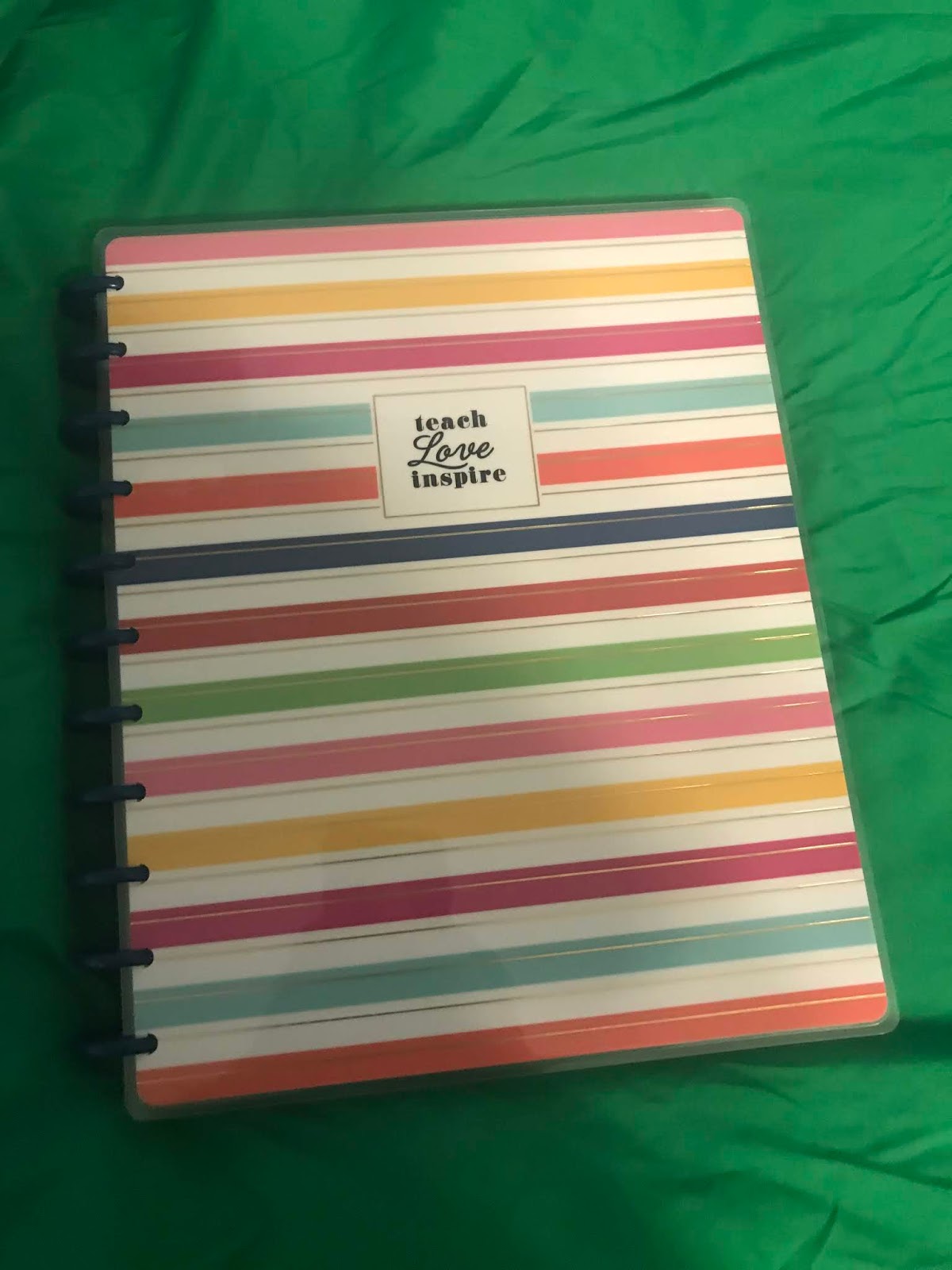
I decided to treat myself to a new planner at Michael's this year rather than going crazy trying to make my own sheets. I chose The Big Happy Planner: Teacher Edition.


First, I have to say it: this planner is so cute! It's also really functional, I promise. Before I started going crazy with post its it looked like this:

The weekly view is where I'm planning to use post-its to plan lessons. I cut a bunch of post-its to the size of the boxes. I used the August pages as placeholders for the post-its since I won't teach in August. Each color will be one week's lessons, I made enough for each grade level in each week:


My plan is to use each week of post-its to write my plans on for each class for that week. I labelled them so they don't get mixed up, writing the grade level and the lesson number.


My plan is to stick the post-it on the first time I have to teach that lesson. For example, here's the first week:


What's super nice about this set-up is that I can just move the post-it when I'm done teaching the lesson and write what we actually did in the box so I can refer back to it later. I'll be moving the post-its forward to the next time I need to teach the lesson. What's really handy about this is that sometimes when we have days off of school I don't see a class and have to use a previous lesson with them - now I'll have the post-it on their spot in my planner to remind me. Believe it or not, I'll still be using my first week lessons on September 17th thanks to 2 Monday holidays in a row, so there will be a lot of lessons to keep straight the first month of school. I plan to keep the post-its after I'm done using them so I can refer to them in the future (past plan books help me keep my sanity and improve my pacing).

That's how I'm planning with post-its this year! Hopefully it works well, I'll try to remember to write an update once I've used it a little bit. So far I love the Happy Planner! 


Sunday, July 22, 2018

Teacher Summer Reading: The Power of Habit by Charles Duhigg

I've been doing a lot of lazy reading on the couch this summer and figured I would write about some of those books (in addition to picture books to use with students). To be clear, I don't *expect* teachers to do summer reading... we work hard enough during the year! But for those of us who enjoy reading over break, here we go!

This week's book was The Power of Habit: Why We Do What We Do in Life and Business by Charles Duhigg. I was able to borrow the e-book for free via my local library in the Libby app, so it's worth checking there if you'd like to save money and support your library! 


This book was about how our unconscious habits impact every part of our lives, often in unexpected ways. Most people can appreciate that actions have consequences, but the consequences of our habits often span far beyond what we might predict. Because teachers especially have to make a lot of decisions in the course of our work, I think we likely rely heavily on habits to avoid decision paralysis and fatigue. 

The book doesn't aim to eliminate habits, or even label them as "bad" the way so many Pinterest articles seem to. Instead, it looks at the possibility of changing habits to make them better fit with goals and desires. By tweaking what we already do without thinking, we are able to come closer to our ideal selves without the need for extreme willpower or constant conscious decision making. 

Considering habits, especially cognitive habits, made me think about the things I do without thinking at school, from coming into my classroom the same way every school day to planning lessons following a certain routine. It also made me consider my habits outside of school, like binge-watching TV when I want to avoid cleaning or some other dreaded task. Just thinking about these habits, making the unconscious routines conscious, was eye-opening for me and helpful to consider.

The real power of habit is in leveraging them to work towards a goal. I started thinking about what habits I could change in my own life. So far, I've come up with adjusting my typical before-school habit of setting up the room, then making copies or checking email. Though I am very set in this habit, I know that I would be more productive if I changed it so that I wasn't trying to copy when many other teachers were also trying to copy, and I could work on plans or other tiring tasks while I had energy from my morning coffee.

I think this book will help me with getting students into certain habits as well. The book points out repeatedly that other people general can't force a habit change, though they can help develop them. For one, I hope to get my band kids into the habit of practicing frequently. Because they're new to playing an instrument, it's likely not something they'll know how to make a habit of, but as a semi-successful practice-er of 17 years I can help coach them towards building their practice stamina and making playing their instruments part of their daily routine. Additionally, I want to build classroom rehearsal habits with my students - not just the typical routines and procedures - in order to address the way we think, act, and make music in our classes.  

I found The Power of Habit to be an easy read, and an enjoyable one. It does sometimes seem to state the obvious, but never for more than a skimable paragraph. It's worth reading if you'd like to think about the things you don't think about doing! 

Thursday, July 19, 2018

The perils of requirements

Teachers, can you think of how many times you've had to do something only because it's required? Whether a governmental regulation, administrator, parent, or other stakeholder requires something, the brunt of requirements often falls into the classroom and onto the shoulders of teachers. Except when it doesn't. Sometimes it falls right onto students.

I'm currently living the teacher and student double life - teacher by day (when it's not summer break) and graduate student by night - and finding many frustrations in being required to do something as a student. Yes, requirements as a teacher are exhausting, frustrating, and tiresome, but as a student it directly impacts learning and can entirely deplete motivation.

I decided to do my masters degree now for a few different reasons. For one, it's required for me to keep teaching in my state. I also hoped to improve my pedagogy and learn new ideas I could use with my students. Both of those were great motivations, until now.

I'm taking a dreaded, required class. It's a subject I actively dislike, and one that I know I'm terrible at. I also know that it's required for the program not because it's critical material for everyone with the degree to know (it isn't) but because one group lobbied the accrediting body to make it a requirement for their own self-interest (employment of professors in large numbers) rather than because it's good for students.

Knowing this class is a requirement for no good reason has made me want to scream almost as many times as actually doing the work for the class has. With an unhelpful TA, lots of busywork, and absolutely no attempt to be culturally relevant, this course has become an absolute nightmare for me. I'm not even a little engaged. I have no desire to put in effort, and only do work for the grade. And yet I have to take it. Because it's required. Because I'm supposed to. Because it's "right". No, studying music exclusively of dead white guys and boiling every meaningful piece of auditory art down to numbers and words isn't right. It isn't good for me. It isn't helping me be a better teacher, a better human, or a better musician. Music isn't about reducing sound to numbers (both Roman and Arabic numerals  to be extra pretentious) or writing paragraphs about why some guy picked a certain note 350 years ago. Music is about thinking, feeling, doing, and being artistically.

So here I am, trudging through a requirement that's burning me out and breaking me down. Taking a class that's stuck in the past in a supposedly progressive degree program. Dealing with bad pedagogy because I'm required to. It's sad, and it feels like a waste of my summer. Yet I do it, all for an overpriced piece of paper that says I met requirements decided by someone without my best interest in mind.

How many times do our students have to do something because it's required?

To be clear, I'm not advocating for the absence of rules or only coming to school when they feel like it or anything that dramatic. Sometimes, requirements are necessary and are actually for the good of students. School is required so that students can learn skills that will help them function in society. Rules are required to be followed to keep students safe. But there are some requirements that are for teacher convenience or due to regulations more than for the good of students. The excessive amount of standardized testing, for example, is not required because testing is good for kids.

I'll be reflecting on what I required for students, both formally and informally, and why or why not that's a good choice. For example, does it always make sense to require students to be sitting/standing in certain spots during direct instruction? Does it always make sense to require students to do an assessment on the day that it's in my plan book? Does it always make sense to require a student to play a particular song if they dislike it? The answer to all of these questions, I think, should be sometimes. There might be a certain portion of a lesson's direct instruction that can't accomplish its goal without students in a specific position. But other times, a choice of position and the flexibility to move between positions might be fine. Sometimes, an assessment needs to be done on a certain day so that I can complete report cards or move on to new material, but other times flexibility to account for testing in other subjects, emotional state, and practice time can be best. In some cases, I want to or need to have students play a particular song for an assessment or to do a cooperative activities, but other times I can let them choose from a selection of songs or even decide on a song independently.

Like most things in education, there aren't easy answers or always-right platitudes that cover the depth and breadth of what goes on in a classroom, but it's worth thinking about what is required, what should be required, and why.


A Look at DESE's Cited Sources: Results of a Critical Look at the Initial Reopening Guidance References

Note: I've been doing a lot more work around education safety lately, but moved it away from this blog. I founded Massachusetts Educatio...