Showing posts with label goals. Show all posts

Sunday, July 29, 2018

Planning with Post-Its

I enjoy lesson planning in the abstract, thing-about-it, daydreaming kind of way, but I've never had a way that I can really write down my plans that I love. Thankfully I'm not required to turn in plans or write full-blown,  multi-page formal lesson plans like I did when student teaching... but I still like to have things planned in a way that I can use them and also have space to write down what I actually accomplished with each class in my plan book. I like both a pre-written plan and a reminder of what we got done. This becomes extra tricky because I use the same plan for multiple classes of the same grade level, but might get to different points in the lesson with each class. Enter my new plan book and post its!

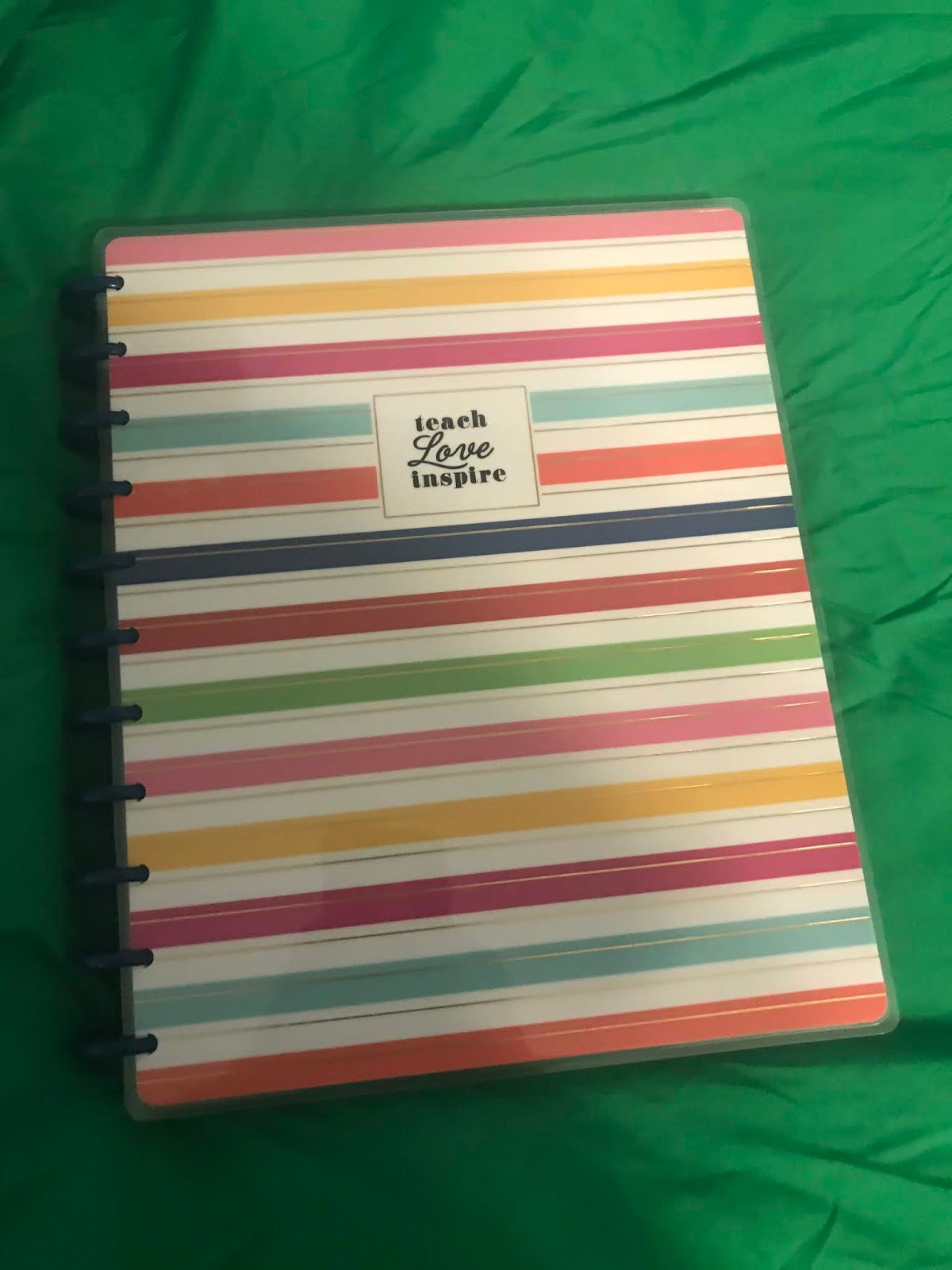
I decided to treat myself to a new planner at Michael's this year rather than going crazy trying to make my own sheets. I chose The Big Happy Planner: Teacher Edition.


First, I have to say it: this planner is so cute! It's also really functional, I promise. Before I started going crazy with post its it looked like this:

The weekly view is where I'm planning to use post-its to plan lessons. I cut a bunch of post-its to the size of the boxes. I used the August pages as placeholders for the post-its since I won't teach in August. Each color will be one week's lessons, I made enough for each grade level in each week:


My plan is to use each week of post-its to write my plans on for each class for that week. I labelled them so they don't get mixed up, writing the grade level and the lesson number.


My plan is to stick the post-it on the first time I have to teach that lesson. For example, here's the first week:


What's super nice about this set-up is that I can just move the post-it when I'm done teaching the lesson and write what we actually did in the box so I can refer back to it later. I'll be moving the post-its forward to the next time I need to teach the lesson. What's really handy about this is that sometimes when we have days off of school I don't see a class and have to use a previous lesson with them - now I'll have the post-it on their spot in my planner to remind me. Believe it or not, I'll still be using my first week lessons on September 17th thanks to 2 Monday holidays in a row, so there will be a lot of lessons to keep straight the first month of school. I plan to keep the post-its after I'm done using them so I can refer to them in the future (past plan books help me keep my sanity and improve my pacing).

That's how I'm planning with post-its this year! Hopefully it works well, I'll try to remember to write an update once I've used it a little bit. So far I love the Happy Planner! 


Sunday, July 22, 2018

Teacher Summer Reading: The Power of Habit by Charles Duhigg

I've been doing a lot of lazy reading on the couch this summer and figured I would write about some of those books (in addition to picture books to use with students). To be clear, I don't *expect* teachers to do summer reading... we work hard enough during the year! But for those of us who enjoy reading over break, here we go!

This week's book was The Power of Habit: Why We Do What We Do in Life and Business by Charles Duhigg. I was able to borrow the e-book for free via my local library in the Libby app, so it's worth checking there if you'd like to save money and support your library! 


This book was about how our unconscious habits impact every part of our lives, often in unexpected ways. Most people can appreciate that actions have consequences, but the consequences of our habits often span far beyond what we might predict. Because teachers especially have to make a lot of decisions in the course of our work, I think we likely rely heavily on habits to avoid decision paralysis and fatigue. 

The book doesn't aim to eliminate habits, or even label them as "bad" the way so many Pinterest articles seem to. Instead, it looks at the possibility of changing habits to make them better fit with goals and desires. By tweaking what we already do without thinking, we are able to come closer to our ideal selves without the need for extreme willpower or constant conscious decision making. 

Considering habits, especially cognitive habits, made me think about the things I do without thinking at school, from coming into my classroom the same way every school day to planning lessons following a certain routine. It also made me consider my habits outside of school, like binge-watching TV when I want to avoid cleaning or some other dreaded task. Just thinking about these habits, making the unconscious routines conscious, was eye-opening for me and helpful to consider.

The real power of habit is in leveraging them to work towards a goal. I started thinking about what habits I could change in my own life. So far, I've come up with adjusting my typical before-school habit of setting up the room, then making copies or checking email. Though I am very set in this habit, I know that I would be more productive if I changed it so that I wasn't trying to copy when many other teachers were also trying to copy, and I could work on plans or other tiring tasks while I had energy from my morning coffee.

I think this book will help me with getting students into certain habits as well. The book points out repeatedly that other people general can't force a habit change, though they can help develop them. For one, I hope to get my band kids into the habit of practicing frequently. Because they're new to playing an instrument, it's likely not something they'll know how to make a habit of, but as a semi-successful practice-er of 17 years I can help coach them towards building their practice stamina and making playing their instruments part of their daily routine. Additionally, I want to build classroom rehearsal habits with my students - not just the typical routines and procedures - in order to address the way we think, act, and make music in our classes.  

I found The Power of Habit to be an easy read, and an enjoyable one. It does sometimes seem to state the obvious, but never for more than a skimable paragraph. It's worth reading if you'd like to think about the things you don't think about doing! 

Thursday, July 12, 2018

Progress in Mediocrity

I managed to snag a great deal on a clarinet this summer to complete my basic woodwind trifecta. I haven't played much in several years, but I know it's easier for my students to learn an instrument through hearing a model. So here I am, practicing my clarinet fundamentals again. It's certainly easier this time than when I first picked up the instrument during my undergrad. But I sound mediocre. Actually, mediocre might be generous. I sound pretty bad, a mix of Squidward and some kind of very angry bird. I know that's normal, I've had a clarinet in my possession for two days and learning an instrument takes time. The basics are coming back to me pretty quickly, and I've been able to play through most first and second year band music without too much trouble. My sound is getting better. I'm noticing and changing some weird embouchure tendencies that will help me play more advanced music. My fingers are starting to know where to go and when in familiar tunes.

Even as a mediocre clarinetist, progress is possible. In fact, I think progress is easier to see in mediocrity. Going from playing a tune with three squeaks to zero is a very clear measure of improvement. Being able to play a song ten clicks faster than I could yesterday is a clear measure of progress. There's something to be said for remembering how it feels to wield an instrument that isn't quite comfortable yet, to feel the discomfort of muscle fatigue and unfamiliar sensation. Clarinet isn't foreign, it's very similar to flute and saxophone, both of which I play at a better-than-mediocre level. But it's different enough to force me to remember what it's like to be mediocre.

Mediocrity is hard! It's frustrating to see so much clarinet music that I can't play yet. To have to stop to look up fingerings when less common notes happen. To have to play slower-than-slow on a piece I could play at lightning speed on another instrument. And solving major musical problems (squeaks, incorrect notes, etc.) is much more exhausting than fine-tuning the details as I would on flute. No wonder my students get frustrated with the process.

Playing an instrument takes practice. There's no changing that. Looking beyond mediocrity is not that easy when you're in the thick of it, trying to remember the fingering for G-sharp for the third time and keep your teeth on top of the mouthpiece. But progress is possible, progress is rewarding, and progress will happen. Instrument fundamentals are an exercise in patience just as much as a physical exercise.

Friday, July 6, 2018

Taking things slowly

I started a really long rambling post without a clear topic, but it's not ready for public consumption yet (maybe not ever). Posting it wouldn't be productive, and I don't even think typing it out at warp speed was cathartic. This post was my reaction to writing that ramble-post for no reason. Recent events and what I've been reading have made me do a lot of thinking and arguing with myself and debating some new ideas in the last week or so. I've realized that this is going to be a summer of transition for me in a lot of ways, and that means time to process is even more important than it usually is.

Transitions are hard. They're hard for students (half of Pinterest seems to be transition procedures for the classroom), and they're hard for adults. I can handle going from reading to going outside a little easier than your average elementary school student (most of the time), but big changes are still challenging. Change means facing something new, something unknown and maybe uncomfortable. Doing things the same way isn't hard, humans build habits and can auto-pilot a lot of tasks. I don't have to think about walking across a room to do it, but crab crawling across the room would take a lot more planning and thinking (and arm strength!). It isn't comfortable because it isn't a routine.

And routines are good, to a point. I'm not advocating for classroom or personal life chaos even a little bit. Routine is what lets the magic happen. You can't play a difficult piece of music without having a routine for how your hold the instrument, and a routine for how you start the first sound. But the routine should a starting point. More launch pad than jail cell. Sure, I always go through getting ready in the same order each morning, but that's just to get out the door to more exciting things. Doing the same thing the same exact way every day would eventually become boring and stifling. Nothing new happens when things are fully routine. But a lot of my routines are being upended in the next few months for different reasons. It's necessary. Yet it's scary. I know it's going to take time for me to be okay with all the changes and routine interruptions that are about to happen. I need to process what's coming to prepare as best I can.

It feels impossible to take time to process for me right now. My teacher brain gets trained during the school year to be always on, always anticipating what could happen, imagining possibilities and responses each of them. I'm use to running, running, running, and then making lists of things to run to do later. Summer is a much different pace for me, but I know I still tend towards snap decision making and overreactions because of the habits I've built.

It's actually really hard to do things slowly. To think over something for longer than is comfortable. To play a scale accurately at 50 beats per minute. To reflect on what has been without looking towards what will be. Many times this year I would beg students to go slowly, to take their time, to think deeper, but I don't think I good about actually doing this myself.

So I will be aiming to take things slow... when I can and when it feels right. Changes take time to sink in, and I need to give thoughts and feelings some time to percolate before throwing them all over or reacting.

Here are my "slow goals" for now:

  1. Be patient with myself in coping with change.
  2. Do at least 5 minutes of focused instrument practice at half or 3/4 speed at least 4 times per week.
  3. Re-read something short that I need to think more about at least three times a week, and take time to think or write about the topic immediate after reading.
  4. Do PT exercises slowly but smoothly at a dedicated time rather than when rushing to take care of something else
  5. Spend less time on email and more time enjoying summer
  6. Break down grad school assignments into less overwhelming chunks.
  7. Have at least three slow, meaningful offline conversations per week
Our society, and teaching especially, tends to encourage speed over depth, urgency over importance. I'm trying to break that cycle for the sake of my physical and mental health. Rushing through everything might temporarily avoid anxiety and feel "productive", but it's not healthy or sustainable for me. I'm trying to do better.

A Look at DESE's Cited Sources: Results of a Critical Look at the Initial Reopening Guidance References

Note: I've been doing a lot more work around education safety lately, but moved it away from this blog. I founded Massachusetts Educatio...