Showing posts with label music. Show all posts

Thursday, May 2, 2019

"Quiet Music"

My district is in the midst of The Big State Test. Literally every space in my school needs to be used for testing, including the room right next to the music room with a thin wall in between. Much of the next few weeks will be spent doing "quiet music class". Yes, music class is not normally a quiet thing. My students always point out to me that music is sound and sound isn't quiet. We all agree it's not our favorite, but it's necessary for the good of the school overall. If it's really nice I try to take students outside, but the gnats and rain have been keeping us in and quiet most of the time. Singing as a whole class can sometimes be quiet enough, but no students playing instruments and low amounts of rambunctiousness are required. Here's a few "quiet music" activities I use with my students:

For upper elementary:

Articles and questions about musicians

I don't do a lot of teaching "about" musicians, so this is a good way (along with sub plans) to squeeze in some contextual information. NewsELA is a great source of articles with pre-written questions, and they have musicians from a wide variety of genres. This year, my students are reading an article about Esperanza Spalding, and one about Lauryn Hill. Once they complete both, they will compare and contrast the two musicians based on what they read in the article.

Videos

I'm typically not one to show a lot of long videos, but quiet music time I am a little more open to using them to keep students engaged, learning and quiet. It's also a really good break for students who have tested earlier in the day and are totally fried. This week, I've been showing a walkthrough of the Benning Violin Factory by Music Express to my students. It's a relatively short video but has led to good discussions about the different string instruments and about careers in music beyond teaching and performance. You can find the video on YouTube here. There are similar videos for other families of instruments, and Music Express also has a video series of composer interviews that are quite good.

For lower elementary:

Echo songs and patterns

For whatever reason, I find my students are able to control their singing volume more effectively when they are echoing rather than singing a song that they already know. The Feierabend book of echo songs is great for this purpose, as are simple tonal and rhythmic patterns. I also challenge students to echo sing a pattern I play quietly on an instrument, which helps them hear and respond to pitch across different timbres.

Move Its

I adore the Move-It DVD! It's a lifesaver when my voice is shot or I otherwise need 2 minutes of engaged focus from younger students. It's especially great when we have to be quiet, since silence is part of my pre-existing procedures for move-its and many of the songs are slower and more relaxing. I'll often do this to settle a class back down if they start to get overexcited and a bit noisy.

Singing Games

Some of my classes enjoy the challenge of staying quiet enough to keep playing a preferred singing game. I always warn them that if they get noisy the game has to stop right away since we want the students testing to be able to focus and do their best work. Usually even the chattiest or most rambunctious class can keep themselves together for five or ten minutes to do a game they really love. Obviously, I don't use games with running or major competitions to set students up for success in staying quiet. Acka Backa, Doggie Doggie, and similar games tend to work well for me.

Quiet music class is definitely not ideal, but when it has to happen there certainly are a variety of options that allow students to keep learning music. I'll definitely be glad when testing season is over and we can bring out the xylophones and drums again! 

Wednesday, May 1, 2019

Not Mozart's notation: How simplified notation helps beginning band sanity

Music notation is a valuable tool. Music literacy (including the ability to read traditional Western music notation) is an important skill which should be developed in order to help students achieve total musicianship. But lines and spaces are not always the best tool for every context, especially when it comes to popular music. I'm using a score consisting of tables for one of our beginning band songs this year. This song is a popular tune (and a student favorite) with rhythms well beyond what is typically covered in first-year band. Here's my score (note the lack of clefs, note heads, and even rhythm notation):


The lyrics are underneath, but before we get there: can you name that tune? It's certainly harder to sight read without the context of rhythm or meter. However, virtually all of my students have heard this song outside of school. So here's what a student part looks like:

Obviously, a beginning band student isn't going to get a whole lot if they just play those notes. I don't use the parts the first time we touch this song. Once we've learned the main sections (in this case, green blue and red), the written parts act as a memory aid. The small lines next to some of the notes indicate that they're "low" (below the tonic of the song). The dashes in the last line remind students to hold that note (the ending I used seems to be less familiar to students than the main tune). 

The benefit of this system is that students can play rhythms well beyond their reading ability. My group hasn't gotten to individual eighth notes yet, or dotted rhythms, but they can execute both well in the song because they know the tune and are playing based primarily on an aural concept. This "part" serves more as a reminder than something to stare at. Today, a student discovered that after a few weeks of practice, she can play the whole thing from memory! I teach band for the music, not the notation, so using this kind of part has helped my students play music that they care about and perform at a high level without getting caught up in music notation confusion. It's another way (not the best way or the only way) to write music to help student learning.

Band teachers: if you'd like parts and score for this tune, leave your gmail in the comments and I'll share with you.


Sunday, January 20, 2019

From Football to the Music Room

Lessons to be taken from the Patriots AFC Championship win:

Never give up, even in the face of obstacles
The Patriots body language on the sidelines is always fascinating. They get frustrated - Belichick swore and threw the tablet - but they never counted themselves out. Even when the Chiefs were up, they were in the game, encouraging their team, and trying to win.

Learning an instrument is hard. Maybe not pro football hard, but difficult and frustrating and sometimes it seems like a certain note or skill will never, ever happen. And yet with enough time, effort, and ragged determination, it happens.

Life isn't fair, play on
There were some horrible officiating calls in the game. Things aren't always just or fair or equal. Sometimes you get five less rehearsals because of snow days, sometimes your instrument's part is way harder than another's, sometimes you don't get that glockenspiel you were desperate to play. And yet we play on, we keep going, we keep trying in spite of whatever circumstances are thrown our way.

Practice hard, but have fun
Sports and music both take focused practice and effort. Improving skills, whether in football or music, requires work. Whether it's a football play or a musical scale, doing the same thing 100 times takes determination and tenacity. Doing the same thing 100 times and improving each time takes effective effort and self-awareness. Those who work hard can always get ahead.

Among all that hard work, find joy and levity. Tom Brady's look of joy after that trick play (that didn't work) or a fifth grader's laugher after figuring out Baby Shark both show the fun and rewards of trying hard. There can be moments of levity amongst hard work and practice, in fact there need to be in order to keep things moving forwards.

Champions win before they're on the field
It's all about preparation. The concert isn't where kids learn music. The Super Bowl isn't where the Patriots get good at football. Success requires preparation and systematic improvement, not simply to show up for the big day. Confidence comes from preparation and practice, and confidence encourages excellent performance. It's not about being perfect, or never deviating from a strict script, but it's about knowing that you've practiced and prepared as much as possible and are able to excel in the situation.

I'll be back in the classroom smiling on Tuesday... and cheering on the Patriots in the Super Bowl!!!!

Tuesday, December 11, 2018

December Singalong!

I, like many music teachers, do more than just teach classes and put on concerts. One of my favorite school events is an all-school pajama day singalong right before December break. I teach K-5, so it's a wide range of ages to appeal to, and a diverse student population. Because I have students who cannot participate in anything holiday related due to religious beliefs, I try to keep the singalong primarily winter based, but represent Christmas, Hanukkah, and Kwanzaa with one song explicitly about each holiday. That way, students who want to can sing about the holiday they celebrate, or another holiday, but those who cannot are still able to be included on songs about snow, penguins, and other non-holiday related fun. Rather than sit and sing, we add lots of movements and other fun activities to keep everyone engaged. I've built a few new traditions in my 3 years so far at my school, and it's always amazing to see the kids remember songs they've learned in years past.

I can't share my slides for all of the songs due to copyrighted lyrics, but here's a list of what we'll be doing for our singalong this year:


  • Jingle Bells
  • Sleigh Ride (we use the Pentatonix version)
  • Do You Want to Build a Snowman from Frozen
  • I Have a Little Dreidel
  • Penguin Polka from Music K-8 (we stand up and dance while singing this one)
  • Kwanzaa is Here
  • Fur Elise winter movements (from the Feierabend Move It DVD)
  • Snow Day! Snow Day! Hip Hip Hooray by Sally Albrecht and Jay Althouse
  • Frosty the Snowman
  • Rudolph
  • When the Lights All Shine from Music K-8 (SHINE is our school rules/character building acronym and we do sitting choreography to this one)

Sunday, November 25, 2018

Thankful

This Thanksgiving break, I've been reflecting on the good in my teaching situation. It's very easy to get caught up in the "could be" "should be" mentality, and while there are things that could be improved, I'm really lucky and have a lot to be thankful for:

  • I'm thankful that all students in my school have music taught by a trained music teacher.
  • I'm thankful that my school has a music room (a lot of schools don't), a dedicated space for music making.
  • I'm thankful that I have supportive colleagues I can confide in.
  • I'm thankful that my students have instruments to play, and that they're able to experience a wide variety of high-quality instruments in music class.
  • I'm thankful that grants help me get more instruments for my students and replace those that are worn or damaged.
  • I'm thankful for the enthusiasm of my students.
  • I'm thankful for supportive families who bring students to outside events and rehearsals beyond the school day.
Things aren't perfect in my school or any other, but I'll be going back to school tomorrow filled with gratitude for what my students and I have.

Monday, October 29, 2018

The Bad and the Good

I've written before about being a grad school student while teaching, and some of the challenges and benefits. My fall class was a lot better than my summer classes, and one idea from the class has stuck with me even though I'm done with the class now: music education is not inherently good. It seemed ironic to hear a question about whether music education was good in a music education degree program in which most of us had spent a years in the field and were currently spending $3,500 to take a music education class. But something about the articles we read and the premise of the question makes so much sense: not every educational experience is a good one.

Education as a harmful experience has helped me make sense of so many of my own school experiences, both as a K-12 student and in college and grad school. Not every class helped me learn something (though I wrote a snarky "this class has taught me how not to teach" on more than one course evaluation) useful. Not every class was worth the time and effort I put in. There's a reason some school experiences didn't work for me beyond my flaws as a student, of which there are many.

But so much of education is good. An a-ha moment about a topic students really care about. Bonding over a certain song, whether it's as part of a Red Sox victory celebration or a more serious occasion. Laughing with a class until everyone needs a drink of water. Hugs from students. Working hard on something and improving on it. Having those goosebump musical moments. It's up to teachers to make those good experiences happen more often, to help students learn and have positive school experiences. This isn't to say teachers should aim to be perfect. Or to "save" students. But if we can find something at school for every kid to look forward to every day, maybe things will be a little better. Or maybe, we can look at experiences that are hurtful for a lot of students (cough, standardized testing, cough) and reimagine a better way.

Me, I'll take the bad with the good, and be grateful that it seems the worst of my experiences as a student should be behind me.

Tuesday, October 16, 2018

Beginning Band and the Joy of Starting Again

If you've never heard a first day beginning band class, you should. Also, go hug your friendly neighborhood beginning band teacher. The first week of band is incredible, joyful, and totally exhausting. There's an entire world of things to teach, from how to assemble instruments to how to make a sound to how to get the spit condensation out after playing (gross, but necessary). But there's this spark in the students that makes it all worth it, even when I find myself saying "left hand on top" for the millionth time. They chose to play an instrument, and are so excited to finally get to do it. The first sounds are always full of squeaks, squawks, and whistles. They're often followed by laughter or disgusted-looking faces. But that moment right before they play, that first inhalation as a group... that's where the magic is.

One breath, one momentary collective pause, holds so much potential. They made the choice, honored the commitment and showed up, and now they're headed somewhere. It might be towards our first concert, middle school band, or maybe even a professional musician gig, but nonetheless we're working towards something. They're cooperating, collaborating, and all those other buzzwords. And they're taking a big risk, because after that breath in...

There's a sound. A joyful noise, as a I call it. Something, even if just a whisper of air, comes out of their instrument. But it's a start. Something to work from. The first note of thousands more to come. There's so much beauty in potential, in hope, in moving forward. In learning and improving. Beginning band has so much to teach... especially to this band teacher.

Monday, August 27, 2018

What I Wish I Knew Before I Started Teaching

I'm still a newish teacher (going into my fourth year overall, third in the same district). But I've learned a lot since I started, some of which will never be in a traditional teacher training program. Here's my big takeaways:

No curriculum is perfect. Do what the kids need, not what the book or computer screen says.
My first district used a very overpriced, very scripted curriculum. Frankly, it wasn't very good. And teaching from a script wasn't fun. But I did it, because I didn't know any better and because I was criticized early on for deviating. Students, and groups of students, are all different. It's more important to teach what they need than what any piece of paper or screen states they "should" learn. Don't do rhythms with kids who don't keep a steady beat yet. It won't work. Read the room, have an actual human to human conversation with students, and teach what they need. Sometimes, a dance party is more important than the planned lesson. Or a folk dance lesson becomes a lesson on respect. That's okay. Adapting is important. Obviously, teach content, not fluff, but teach the students in front of you. They'll get where they need to be, even if it takes a little more time.

Learn from everyone.
Yes, it's easy to get caught in a teacher echo chamber. It feels better to only talk to brand-new teachers who are just as scared and worn down and clueless as you might feel. But those who have been there before can help you grow. Most teachers aren't scary people if you talk to them. That being said, avoid toxicity like the plague because it spreads. Ain't nobody got time for Negative Nancys. I've learned classroom management tricks from lunch monitors, movement strategies from PE teachers, organizing strategies from classroom teachers, and many more. Don't just stay in your lane, learn and borrow from those around you.

Understand you'll be misunderstood
Especially as a music teacher, there will be misunderstandings. Schedules will get mixed up. Observers will focus on something that has nothing to do with music or teaching. You'll be asked to teach kids you only see on Tuesday a song by Monday... when it's Friday. Things will work out. Communicate clearly, firmly, but respectfully. There's no sense in yelling about things when simply educating adults will work better. Explain that you cannot possibly teach kindergarten and fifth grade back-to-back without passing time because the room setup for fifth grade isn't safe for younger students, or why chorus with 100 kids on Friday afternoon might be a struggle. Explain what the curriculum indicates students should be learning, and why you taught it as you did. Let the teacher who asks for a song performance ready that it's too last minute and you'd be glad to offer support next time with more advance notice. Most people in schools really do have students' best interests at heart, even if it sometimes creates inconvenience. Explaining your reasoning while setting boundaries helps to maintain and build respectful relationships. It's okay to vent (to people outside the situation) about frustrations with this too! It is hard being misunderstood, or being seen as an entertainer.

Have fun
There's so much joy to be found in making music with students. Not all days will be fun, not all classes will be fun, but there are bright moments even in the exhausting, frustrating times. It's okay to laugh at a kid's joke that makes no sense, or freeze dance when you finish a lesson two minutes early. Don't be the teacher who doesn't smile until Christmas, it's not healthy for students or adults.

The middle is a good place to be
There are few things in education that require an extreme view. Though many topics are polarizing in education (and especially music education) circles, there's no reason to create a false binary where there isn't one. It's not pop music vs. classical music. Or Kodaly vs. Orff vs. Gordon. Use what works for you, no matter where it came from. Different teachers, schools, and students need different things. It's better to be yourself than to unthinkingly follow any method, philosophy, or idea.

It does get easier, except when it doesn't
Being a first year teacher is hard, exhausting, frustrating, and taxing in a way that no program can truly prepare you for. But that's not to say everything after is easy. There will always be things about teaching, or anything else, that are hard. But the hard things get easier, you develop new skills, and you'll develop a compass of what's normal or acceptable for you and what isn't. It's absolutely okay to change things or move to a new position if it's what will work for you. Some positions aren't right for some people. It's okay to leave. Ask for help on the things that are still hard.

No (lesson, teacher, district, school, fill-in-the-blank) is perfect
Even the teachers with the Pinterest perfect classrooms are human beings with flaws. Even that "dream position" has its downsides. Don't focus on finding the perfect lesson, poster, school, or boss. Absolutely find yourself a workable situation and a healthy work environment, but don't chase after perfection that doesn't exist. I love my school and district, but I know that it has flaws, as does every other district I'm familiar with. Find things to be grateful about in your current situation rather than always lusting after something better.

Be kind
This one is last, but also most important. Being kind to yourself, students, and co-workers will pay dividends in so many ways. There is no use in teachers bashing themselves, or blaming their students. Complaining about a colleague behind their back won't change anything. It is okay and perfectly normal to have tough teaching days. It doesn't mean you're a bad teacher. Kids had bad days too. It doesn't mean they're bad kids or are out to get you. Kindness is one of the most important things we can teach and model for our students, especially those who may not be treated with kindness outside of school. And being kind to ourselves is necessary! You can't take care of students if you don't take care of yourself.

Lesson Share: The Playlist Project

This post was inspired by the #popmused chat on Twitter, with a question asking about popular music lesson plans. Check out the hashtag here - there's lots of great resources!

I was desperate for lessons without much teacher talk last spring, my voice was shot and allergies were making me struggle, but not be sick enough to call out. My "playlist project" was born when I found a bunch of old mix "tapes" (well, CDs) I had made when I was younger... it was so cool to find songs that went together and tweak the list until it was perfect, then burn it to a CD. Tapes became CDs, and now almost all playlists are virtual, so my students were able to put together a playlist however they wanted.

My students have different levels of background knowledge, so I spent quite a bit of time talking about playlists - what they are, how to put them together, differences between playlists and albums, etc. - and showing a few examples. Then I set my students free to create their own. I was intentionally vague about how the songs on the playlist should be related, but left it up to them how the songs were related. Some great examples students came up with included songs with loud drums (which included rock, hip-hop, and classical music), songs with Spanish lyrics, songs learned on piano, and songs about broken hearts. I used this worksheet to structure students' creating. They used iPads to look up songs as needed, since many of them weren't sure about exact titles or spelling of artist names. Because my school is fairly conservative about language and I wanted my students to have as much freedom as I could give them, the guideline I gave was that the titles and artist names had to be clean, but I wouldn't go searching for inappropriate lyrics.

This project served multiple purposes. For one, it got my students thinking deeply about the music they hear outside of school. It gave me insight into how they think about music, and what music they're exposed to. I was surprised at the number of songs from the 70s and 80s on their playlists, but glad to know that they appreciated and knew some of my favorites. I pulled from their playlists when I could - whether it was for beat-keeping practice or a little movement exploration (always vetting the songs first, of course). I did this late in the year last year, but I'm hoping to do it earlier in the year this year since it helped me build a relationship with my students and understand their musical world.

Feel free to make a copy of the worksheet and use if you'd like!

Sunday, July 29, 2018

Planning with Post-Its

I enjoy lesson planning in the abstract, thing-about-it, daydreaming kind of way, but I've never had a way that I can really write down my plans that I love. Thankfully I'm not required to turn in plans or write full-blown,  multi-page formal lesson plans like I did when student teaching... but I still like to have things planned in a way that I can use them and also have space to write down what I actually accomplished with each class in my plan book. I like both a pre-written plan and a reminder of what we got done. This becomes extra tricky because I use the same plan for multiple classes of the same grade level, but might get to different points in the lesson with each class. Enter my new plan book and post its!

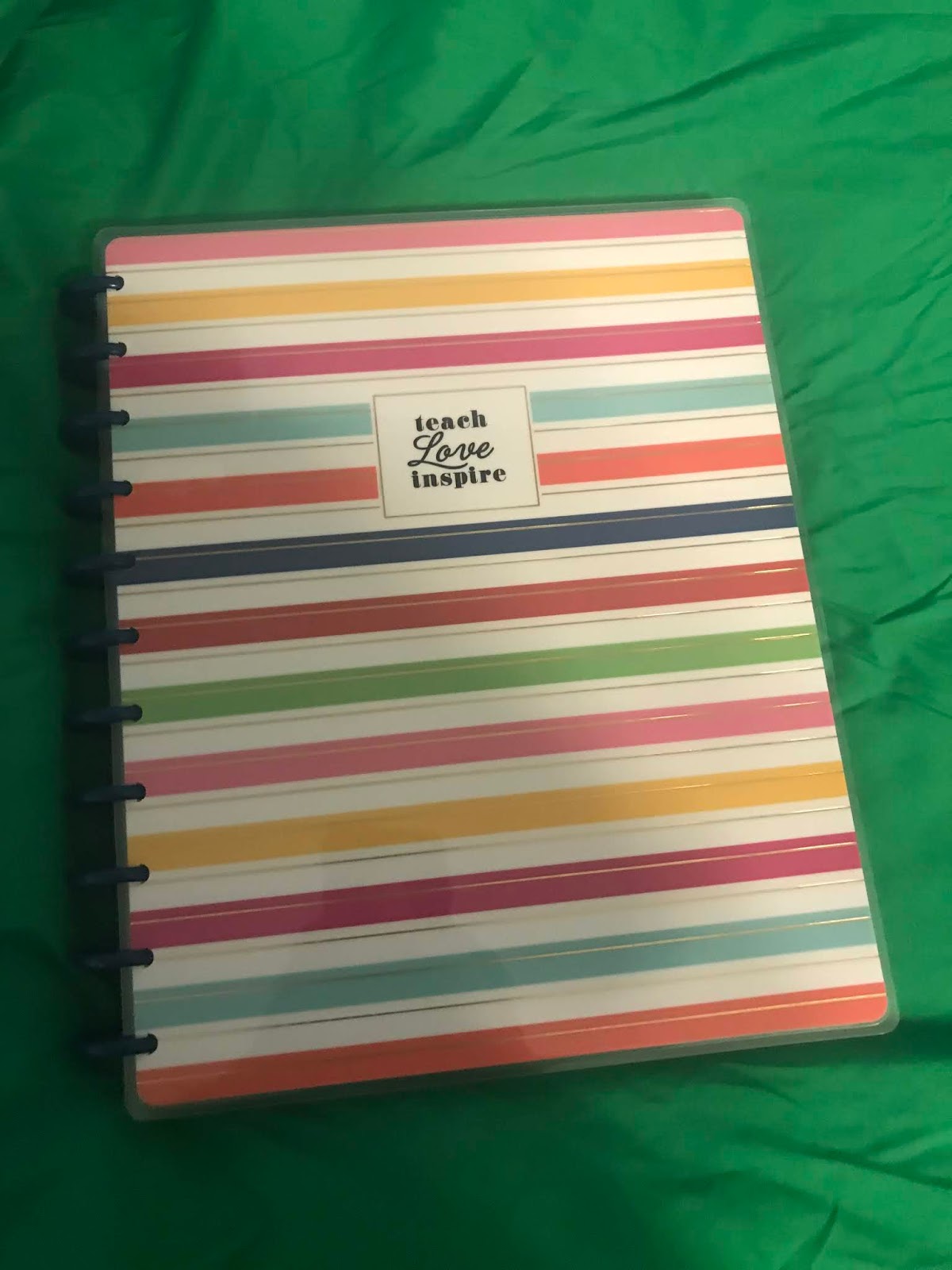
I decided to treat myself to a new planner at Michael's this year rather than going crazy trying to make my own sheets. I chose The Big Happy Planner: Teacher Edition.


First, I have to say it: this planner is so cute! It's also really functional, I promise. Before I started going crazy with post its it looked like this:

The weekly view is where I'm planning to use post-its to plan lessons. I cut a bunch of post-its to the size of the boxes. I used the August pages as placeholders for the post-its since I won't teach in August. Each color will be one week's lessons, I made enough for each grade level in each week:


My plan is to use each week of post-its to write my plans on for each class for that week. I labelled them so they don't get mixed up, writing the grade level and the lesson number.


My plan is to stick the post-it on the first time I have to teach that lesson. For example, here's the first week:


What's super nice about this set-up is that I can just move the post-it when I'm done teaching the lesson and write what we actually did in the box so I can refer back to it later. I'll be moving the post-its forward to the next time I need to teach the lesson. What's really handy about this is that sometimes when we have days off of school I don't see a class and have to use a previous lesson with them - now I'll have the post-it on their spot in my planner to remind me. Believe it or not, I'll still be using my first week lessons on September 17th thanks to 2 Monday holidays in a row, so there will be a lot of lessons to keep straight the first month of school. I plan to keep the post-its after I'm done using them so I can refer to them in the future (past plan books help me keep my sanity and improve my pacing).

That's how I'm planning with post-its this year! Hopefully it works well, I'll try to remember to write an update once I've used it a little bit. So far I love the Happy Planner! 


Thursday, July 19, 2018

The perils of requirements

Teachers, can you think of how many times you've had to do something only because it's required? Whether a governmental regulation, administrator, parent, or other stakeholder requires something, the brunt of requirements often falls into the classroom and onto the shoulders of teachers. Except when it doesn't. Sometimes it falls right onto students.

I'm currently living the teacher and student double life - teacher by day (when it's not summer break) and graduate student by night - and finding many frustrations in being required to do something as a student. Yes, requirements as a teacher are exhausting, frustrating, and tiresome, but as a student it directly impacts learning and can entirely deplete motivation.

I decided to do my masters degree now for a few different reasons. For one, it's required for me to keep teaching in my state. I also hoped to improve my pedagogy and learn new ideas I could use with my students. Both of those were great motivations, until now.

I'm taking a dreaded, required class. It's a subject I actively dislike, and one that I know I'm terrible at. I also know that it's required for the program not because it's critical material for everyone with the degree to know (it isn't) but because one group lobbied the accrediting body to make it a requirement for their own self-interest (employment of professors in large numbers) rather than because it's good for students.

Knowing this class is a requirement for no good reason has made me want to scream almost as many times as actually doing the work for the class has. With an unhelpful TA, lots of busywork, and absolutely no attempt to be culturally relevant, this course has become an absolute nightmare for me. I'm not even a little engaged. I have no desire to put in effort, and only do work for the grade. And yet I have to take it. Because it's required. Because I'm supposed to. Because it's "right". No, studying music exclusively of dead white guys and boiling every meaningful piece of auditory art down to numbers and words isn't right. It isn't good for me. It isn't helping me be a better teacher, a better human, or a better musician. Music isn't about reducing sound to numbers (both Roman and Arabic numerals  to be extra pretentious) or writing paragraphs about why some guy picked a certain note 350 years ago. Music is about thinking, feeling, doing, and being artistically.

So here I am, trudging through a requirement that's burning me out and breaking me down. Taking a class that's stuck in the past in a supposedly progressive degree program. Dealing with bad pedagogy because I'm required to. It's sad, and it feels like a waste of my summer. Yet I do it, all for an overpriced piece of paper that says I met requirements decided by someone without my best interest in mind.

How many times do our students have to do something because it's required?

To be clear, I'm not advocating for the absence of rules or only coming to school when they feel like it or anything that dramatic. Sometimes, requirements are necessary and are actually for the good of students. School is required so that students can learn skills that will help them function in society. Rules are required to be followed to keep students safe. But there are some requirements that are for teacher convenience or due to regulations more than for the good of students. The excessive amount of standardized testing, for example, is not required because testing is good for kids.

I'll be reflecting on what I required for students, both formally and informally, and why or why not that's a good choice. For example, does it always make sense to require students to be sitting/standing in certain spots during direct instruction? Does it always make sense to require students to do an assessment on the day that it's in my plan book? Does it always make sense to require a student to play a particular song if they dislike it? The answer to all of these questions, I think, should be sometimes. There might be a certain portion of a lesson's direct instruction that can't accomplish its goal without students in a specific position. But other times, a choice of position and the flexibility to move between positions might be fine. Sometimes, an assessment needs to be done on a certain day so that I can complete report cards or move on to new material, but other times flexibility to account for testing in other subjects, emotional state, and practice time can be best. In some cases, I want to or need to have students play a particular song for an assessment or to do a cooperative activities, but other times I can let them choose from a selection of songs or even decide on a song independently.

Like most things in education, there aren't easy answers or always-right platitudes that cover the depth and breadth of what goes on in a classroom, but it's worth thinking about what is required, what should be required, and why.


Thursday, July 12, 2018

Progress in Mediocrity

I managed to snag a great deal on a clarinet this summer to complete my basic woodwind trifecta. I haven't played much in several years, but I know it's easier for my students to learn an instrument through hearing a model. So here I am, practicing my clarinet fundamentals again. It's certainly easier this time than when I first picked up the instrument during my undergrad. But I sound mediocre. Actually, mediocre might be generous. I sound pretty bad, a mix of Squidward and some kind of very angry bird. I know that's normal, I've had a clarinet in my possession for two days and learning an instrument takes time. The basics are coming back to me pretty quickly, and I've been able to play through most first and second year band music without too much trouble. My sound is getting better. I'm noticing and changing some weird embouchure tendencies that will help me play more advanced music. My fingers are starting to know where to go and when in familiar tunes.

Even as a mediocre clarinetist, progress is possible. In fact, I think progress is easier to see in mediocrity. Going from playing a tune with three squeaks to zero is a very clear measure of improvement. Being able to play a song ten clicks faster than I could yesterday is a clear measure of progress. There's something to be said for remembering how it feels to wield an instrument that isn't quite comfortable yet, to feel the discomfort of muscle fatigue and unfamiliar sensation. Clarinet isn't foreign, it's very similar to flute and saxophone, both of which I play at a better-than-mediocre level. But it's different enough to force me to remember what it's like to be mediocre.

Mediocrity is hard! It's frustrating to see so much clarinet music that I can't play yet. To have to stop to look up fingerings when less common notes happen. To have to play slower-than-slow on a piece I could play at lightning speed on another instrument. And solving major musical problems (squeaks, incorrect notes, etc.) is much more exhausting than fine-tuning the details as I would on flute. No wonder my students get frustrated with the process.

Playing an instrument takes practice. There's no changing that. Looking beyond mediocrity is not that easy when you're in the thick of it, trying to remember the fingering for G-sharp for the third time and keep your teeth on top of the mouthpiece. But progress is possible, progress is rewarding, and progress will happen. Instrument fundamentals are an exercise in patience just as much as a physical exercise.

Thursday, July 5, 2018

Books in the Elementary Music Room: I'm Here by Peter H. Reynolds

When I went to shop at Blue Bunny Books recently, I figured I'd go home with at least one book by the shop's owner, Peter H. Reynolds. I had read The Dot before and students at my school do art projects relating to it, so I wanted a different book to use in the music room. I found exactly what I was looking for in I'm Here.


With simple language and evocative imagery, the book is a first-person narrative of a child trying to find their place in the world. The imaginative illustrations and straightforward text, this book tells a story that will touch hearts and minds.

I plan on using this book as the basis for a student-created soundscape. In a soundscape, students make musical sounds and movements that match a story or idea. For example, the book's phrase "gentle wind" might be represented by wind chimes, or a student making a blowing sound or moving gently across the room. Because the story is short, and the sounds needed range from very literal to more abstract and challenging, there is an opportunity to allow students to choose their own challenge by picking which part of the book they want to soundscape. I haven't decided which grade to use this book with yet, but my process will look a bit like this:


  1. Read the story to students
  2. Have the class come up with a "scope of work" by listing the sounds/ideas that should be represented by music or movement
  3. Read the book again, have students revise the scope as needed
  4. Have each student/partnership pick a part of the book to soundscape and plan how to represent their part 
  5. Students share their idea with another student/partnership, giving feedback to each other and revising their ideas as needed
  6. Student practice/revision time, I check in with them to guide as needed
  7. Read the book with soundscape as a culminating in-class performance
I highly recommend this book! While it will be interesting to look at in a musical context, this book has a lot of lessons beyond the music room. 

Monday, July 2, 2018

Teacher Summer Reading: Play It From the Heart by J. Steven Moore

I've been doing a lot of lazy reading on the couch this summer and figured I would write about some of those books (in addition to picture books to use with students). To be clear, I don't *expect* teachers to do summer reading... we work hard enough during the year! But for those of us who enjoy reading over break, here we go!

One of the first books I read this summer break was Play It From the Heart: What You Learn from Music about Success in Life by J. Steven Moore.


The book contains a number of anecdotes about the extra-musical values and skills learned through music education, weaving together anecdotes about student attention, engagement, and perseverance with tales about ensembles truly coming together to support one another. It's a refreshing read for me, as it's so drastically different from the dryly academic grad school readings I've been doing the past few months, full of statistics and footnotes more than passion. This is a book that is truly from the heart, and contains many poignant reminders of why we teach, why we are musicians, and why we teach music. While it didn't tell my story, exactly, it was easy to connect to the students discussed in the book just as much as the teachers. I remember that feeling of pride after a long rehearsal, the steadfast determination to play a show in pouring rain, the desire to take care of one another as a family even when things were difficult. 

The book never preaches, though it does include a few philosophical tangents about how music education inherently includes real-world skills that apply far outside the band room. Lessons such as promptness, determination, pride, and cooperation are a nice reminder for teachers who can get very caught up in the music during the school year. The book never strays into discounting the musical benefits of music education, which I really appreciate after hearings years of "music makes you smarter" demusicalized music advocacy.

For those who believe we teach students in addition to teaching music, this book is a quick, inspiring, honest read. It left me hopeful and eager to get back into the classroom with my students. Also awesome (for those of us with a library database subscription) is that I was able to read it for free online via my university library (shoutout to BU!). So read this, then play from the heart! 

A Look at DESE's Cited Sources: Results of a Critical Look at the Initial Reopening Guidance References

Note: I've been doing a lot more work around education safety lately, but moved it away from this blog. I founded Massachusetts Educatio...