18 days into summer break, and I received the all-clear email that I can go set up my room whenever now that the floors in my wing are done. While I probably won't head into school for a couple more weeks, I always feel like that email saying we can access our rooms marks the beginning of another year. I'm staying in the same school with the same basic teaching assignment this year (thank goodness!) but so much around me will be changing that it feels like a big transition.
I did an end-of-year pack-up of questionable quality, throwing some things into drawers simply because I didn't want to have to make a decision about them. I did manage to clear out some materials well past their prime, including scratched records and an autoharp that will be re-purposed for games for our district music festival. I probably could have done more but my June teacher brain was so tired that I just didn't.
There is always more to do. So when I get back to my classroom, it will be how I left it (thankfully my awesome custodians make sure instruments aren't damaged as they clean) and I will do what I can to get everything how I want it to start the year. Nothing will explode if I don't have everything just so and there's a few post-it pads or pens out of their usual place. I'll do what is really important for my students and do the best I can with the rest. And it will be enough.
When deciding what is most important for me to do for students, I think about what is necessary, especially for the beginning of the year. I was able to leave my staff reading bulletin board in place, as well as my schedule board, so those will be easy to freshen up. There's a few important posters I need to get back up on the walls (some rhythm and instrument anchor charts, plus a Harry Potter poster that I just enjoy). I also want to get instruments set up, since that impacts traffic flow through the room and I like for kids to walk in and see the music room in its "real" setup on the very first day so that we can do procedures in a way that works with everything set up from day 1. Of course, planning lessons is key too! I try to do a lot of copying in August since there's less teachers waiting to use the copiers. Since I make booklets to use a multi-class sub plan, I'll copy and assemble those before the year starts so I'm ready just in case I need to be out.
Most of what I'm setting up isn't going to change a lot from how I had things last year. My room last year worked well for me and my students. Yes, I have some fresh lesson ideas and some fantastic new books, including the ones I've blogged about, but the physical setup of my room will be largely the same.
So I will begin again, much in the same way I do every year, despite changes all around me. I will choose to be stability and consistency, and to provide the best possible environment for my students. But first, a few more weeks of relaxation.

Tuesday, July 10, 2018

Monday, July 9, 2018
Teacher DIY: Re-purposing old white boards
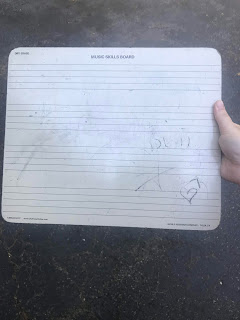
Visual art is not my strong suit, but I still tried to take one a couple DIY projects for school this summer. Right now, I'm working on re-purposing some old student white boards in very rough shape. The white boards from my classroom are at least 12 years old, and I was lucky enough to be able to buy new ones with budget money last year. I could have just tossed the old ones, but since I don't have clipboards, I have used them as a hard surface for kids to use under their paper when doing written work. My students often do written work when there's a substitute, and telling the substitute to have students get white boards led to a lot of confusion, so I decided to take away the white board surfaces and call them "clipboards" to make everyone's life a little easier.
Knowing that these boards would get quite a bit of use, and that my students don't always stay on the paper when coloring, I decided that basic black would be the best color for durability and aesthetic purposes. I grabbed some glossy spray paint from Home Depot, making sure it said that it could be used on plastic.

Now here's one of those times this teacher didn't do what she always tells the students to do: I didn't follow the directions. The directions said to sand glossy surfaces, and I read them, but ain't nobody got time for that. I decided to try out just spraying them and seeing what happened. It still worked! They aren't perfect, but the boards look a lot better than they did and not sanding saved me a lot of time.
I put down newspaper in the garage, laid out the boards, and started spraying away! Here's some "before" pictures:



Knowing that these boards would get quite a bit of use, and that my students don't always stay on the paper when coloring, I decided that basic black would be the best color for durability and aesthetic purposes. I grabbed some glossy spray paint from Home Depot, making sure it said that it could be used on plastic.

Now here's one of those times this teacher didn't do what she always tells the students to do: I didn't follow the directions. The directions said to sand glossy surfaces, and I read them, but ain't nobody got time for that. I decided to try out just spraying them and seeing what happened. It still worked! They aren't perfect, but the boards look a lot better than they did and not sanding saved me a lot of time.
I put down newspaper in the garage, laid out the boards, and started spraying away! Here's some "before" pictures:


And "after":


They're not "Pinterest perfect" but they will help my students by giving them a durable hard surface to serve the purpose of a clipboard (without the annoying clips that pinch fingers and break) without costing a lot of money.
Friday, July 6, 2018
Taking things slowly
I started a really long rambling post without a clear topic, but it's not ready for public consumption yet (maybe not ever). Posting it wouldn't be productive, and I don't even think typing it out at warp speed was cathartic. This post was my reaction to writing that ramble-post for no reason. Recent events and what I've been reading have made me do a lot of thinking and arguing with myself and debating some new ideas in the last week or so. I've realized that this is going to be a summer of transition for me in a lot of ways, and that means time to process is even more important than it usually is.
Transitions are hard. They're hard for students (half of Pinterest seems to be transition procedures for the classroom), and they're hard for adults. I can handle going from reading to going outside a little easier than your average elementary school student (most of the time), but big changes are still challenging. Change means facing something new, something unknown and maybe uncomfortable. Doing things the same way isn't hard, humans build habits and can auto-pilot a lot of tasks. I don't have to think about walking across a room to do it, but crab crawling across the room would take a lot more planning and thinking (and arm strength!). It isn't comfortable because it isn't a routine.
And routines are good, to a point. I'm not advocating for classroom or personal life chaos even a little bit. Routine is what lets the magic happen. You can't play a difficult piece of music without having a routine for how your hold the instrument, and a routine for how you start the first sound. But the routine should a starting point. More launch pad than jail cell. Sure, I always go through getting ready in the same order each morning, but that's just to get out the door to more exciting things. Doing the same thing the same exact way every day would eventually become boring and stifling. Nothing new happens when things are fully routine. But a lot of my routines are being upended in the next few months for different reasons. It's necessary. Yet it's scary. I know it's going to take time for me to be okay with all the changes and routine interruptions that are about to happen. I need to process what's coming to prepare as best I can.
It feels impossible to take time to process for me right now. My teacher brain gets trained during the school year to be always on, always anticipating what could happen, imagining possibilities and responses each of them. I'm use to running, running, running, and then making lists of things to run to do later. Summer is a much different pace for me, but I know I still tend towards snap decision making and overreactions because of the habits I've built.
It's actually really hard to do things slowly. To think over something for longer than is comfortable. To play a scale accurately at 50 beats per minute. To reflect on what has been without looking towards what will be. Many times this year I would beg students to go slowly, to take their time, to think deeper, but I don't think I good about actually doing this myself.
So I will be aiming to take things slow... when I can and when it feels right. Changes take time to sink in, and I need to give thoughts and feelings some time to percolate before throwing them all over or reacting.
Here are my "slow goals" for now:
Transitions are hard. They're hard for students (half of Pinterest seems to be transition procedures for the classroom), and they're hard for adults. I can handle going from reading to going outside a little easier than your average elementary school student (most of the time), but big changes are still challenging. Change means facing something new, something unknown and maybe uncomfortable. Doing things the same way isn't hard, humans build habits and can auto-pilot a lot of tasks. I don't have to think about walking across a room to do it, but crab crawling across the room would take a lot more planning and thinking (and arm strength!). It isn't comfortable because it isn't a routine.
And routines are good, to a point. I'm not advocating for classroom or personal life chaos even a little bit. Routine is what lets the magic happen. You can't play a difficult piece of music without having a routine for how your hold the instrument, and a routine for how you start the first sound. But the routine should a starting point. More launch pad than jail cell. Sure, I always go through getting ready in the same order each morning, but that's just to get out the door to more exciting things. Doing the same thing the same exact way every day would eventually become boring and stifling. Nothing new happens when things are fully routine. But a lot of my routines are being upended in the next few months for different reasons. It's necessary. Yet it's scary. I know it's going to take time for me to be okay with all the changes and routine interruptions that are about to happen. I need to process what's coming to prepare as best I can.
It feels impossible to take time to process for me right now. My teacher brain gets trained during the school year to be always on, always anticipating what could happen, imagining possibilities and responses each of them. I'm use to running, running, running, and then making lists of things to run to do later. Summer is a much different pace for me, but I know I still tend towards snap decision making and overreactions because of the habits I've built.
It's actually really hard to do things slowly. To think over something for longer than is comfortable. To play a scale accurately at 50 beats per minute. To reflect on what has been without looking towards what will be. Many times this year I would beg students to go slowly, to take their time, to think deeper, but I don't think I good about actually doing this myself.
So I will be aiming to take things slow... when I can and when it feels right. Changes take time to sink in, and I need to give thoughts and feelings some time to percolate before throwing them all over or reacting.
Here are my "slow goals" for now:
- Be patient with myself in coping with change.
- Do at least 5 minutes of focused instrument practice at half or 3/4 speed at least 4 times per week.
- Re-read something short that I need to think more about at least three times a week, and take time to think or write about the topic immediate after reading.
- Do PT exercises slowly but smoothly at a dedicated time rather than when rushing to take care of something else
- Spend less time on email and more time enjoying summer
- Break down grad school assignments into less overwhelming chunks.
- Have at least three slow, meaningful offline conversations per week
Our society, and teaching especially, tends to encourage speed over depth, urgency over importance. I'm trying to break that cycle for the sake of my physical and mental health. Rushing through everything might temporarily avoid anxiety and feel "productive", but it's not healthy or sustainable for me. I'm trying to do better.
Thursday, July 5, 2018
Books in the Elementary Music Room: I'm Here by Peter H. Reynolds
When I went to shop at Blue Bunny Books recently, I figured I'd go home with at least one book by the shop's owner, Peter H. Reynolds. I had read The Dot before and students at my school do art projects relating to it, so I wanted a different book to use in the music room. I found exactly what I was looking for in I'm Here.

With simple language and evocative imagery, the book is a first-person narrative of a child trying to find their place in the world. The imaginative illustrations and straightforward text, this book tells a story that will touch hearts and minds.
I plan on using this book as the basis for a student-created soundscape. In a soundscape, students make musical sounds and movements that match a story or idea. For example, the book's phrase "gentle wind" might be represented by wind chimes, or a student making a blowing sound or moving gently across the room. Because the story is short, and the sounds needed range from very literal to more abstract and challenging, there is an opportunity to allow students to choose their own challenge by picking which part of the book they want to soundscape. I haven't decided which grade to use this book with yet, but my process will look a bit like this:

With simple language and evocative imagery, the book is a first-person narrative of a child trying to find their place in the world. The imaginative illustrations and straightforward text, this book tells a story that will touch hearts and minds.
I plan on using this book as the basis for a student-created soundscape. In a soundscape, students make musical sounds and movements that match a story or idea. For example, the book's phrase "gentle wind" might be represented by wind chimes, or a student making a blowing sound or moving gently across the room. Because the story is short, and the sounds needed range from very literal to more abstract and challenging, there is an opportunity to allow students to choose their own challenge by picking which part of the book they want to soundscape. I haven't decided which grade to use this book with yet, but my process will look a bit like this:
- Read the story to students
- Have the class come up with a "scope of work" by listing the sounds/ideas that should be represented by music or movement
- Read the book again, have students revise the scope as needed
- Have each student/partnership pick a part of the book to soundscape and plan how to represent their part
- Students share their idea with another student/partnership, giving feedback to each other and revising their ideas as needed
- Student practice/revision time, I check in with them to guide as needed
- Read the book with soundscape as a culminating in-class performance
I highly recommend this book! While it will be interesting to look at in a musical context, this book has a lot of lessons beyond the music room.
Tuesday, July 3, 2018
Teacher Field Trip: Blue Bunny Books, Dedham, Massachusetts
Field trips with students are stressful. Keeping track of kids, their lunches, and chaperones is a lot to handle. But teacher "field trips" in the summer are fun!
I recently headed to Dedham, Massachusetts, to Blue Bunny Bookstore.

I recently headed to Dedham, Massachusetts, to Blue Bunny Bookstore.
I love local bookstores, and was ready to start browsing for books to use with my students next school year. Blue Bunny didn't disappoint in that respect! Though the store is a fairly small space, a well-curated selection fo children's books flowed throughout the space.
Owned by children's book author Peter H. Reynolds, the shop includes a coffee bar and places to sit in addition to plenty of books. I actually got to meet Peter and have him sign a book while I was there, as he was in the shop with his family at the time. The shop has a local, friendly feel without being overwhelming. It's a great place to browse or search with a broad theme in mind, as the books were organized and easy to access.
There are plenty of events at the Blue Bunny, including author visits and activities for children. I'll be visiting again for sure, and writing about some of the books I bought there in an upcoming post! This would be a great place for kids to explore as well.
Monday, July 2, 2018
Teacher Summer Reading: Play It From the Heart by J. Steven Moore
I've been doing a lot of lazy reading on the couch this summer and figured I would write about some of those books (in addition to picture books to use with students). To be clear, I don't *expect* teachers to do summer reading... we work hard enough during the year! But for those of us who enjoy reading over break, here we go!
One of the first books I read this summer break was Play It From the Heart: What You Learn from Music about Success in Life by J. Steven Moore.

One of the first books I read this summer break was Play It From the Heart: What You Learn from Music about Success in Life by J. Steven Moore.
The book contains a number of anecdotes about the extra-musical values and skills learned through music education, weaving together anecdotes about student attention, engagement, and perseverance with tales about ensembles truly coming together to support one another. It's a refreshing read for me, as it's so drastically different from the dryly academic grad school readings I've been doing the past few months, full of statistics and footnotes more than passion. This is a book that is truly from the heart, and contains many poignant reminders of why we teach, why we are musicians, and why we teach music. While it didn't tell my story, exactly, it was easy to connect to the students discussed in the book just as much as the teachers. I remember that feeling of pride after a long rehearsal, the steadfast determination to play a show in pouring rain, the desire to take care of one another as a family even when things were difficult.
The book never preaches, though it does include a few philosophical tangents about how music education inherently includes real-world skills that apply far outside the band room. Lessons such as promptness, determination, pride, and cooperation are a nice reminder for teachers who can get very caught up in the music during the school year. The book never strays into discounting the musical benefits of music education, which I really appreciate after hearings years of "music makes you smarter" demusicalized music advocacy.
For those who believe we teach students in addition to teaching music, this book is a quick, inspiring, honest read. It left me hopeful and eager to get back into the classroom with my students. Also awesome (for those of us with a library database subscription) is that I was able to read it for free online via my university library (shoutout to BU!). So read this, then play from the heart!
Sunday, July 1, 2018
Teacher Summers
A lot has already been said about teachers and summer - by teachers and non-teachers alike - and it's largely very polarized. Opinions range from the dismissive you're so lucky to have summers off to all good teachers will do lots of work over the summer. Doug, an actual teacher, wrote a great blog post about summer PD, with one key sentence:
Sometimes teachers' choices bridges that artificial divide between "work" and "play". I got dinner with a colleague who's also a good friend when I was in Boston this week, and we talked about both edu and non-edu things. Does that me credit for teaching-related? not-teaching-related? both? neither? And who's really keeping score?
The whole teacher summer "debate" strikes me as one of those situations in which it's better for all of us if we can mind our own business and worry about ourselves. Yes, it's important to make sure new teachers know they don't have to work all summer. And yes, it's important to share opportunities to learn over the summer with colleagues. But ultimately it's up to each of us. You design your summer, I'll design mine, and hopefully we'll both come back refreshed, relaxed, and ready to take on a new school year. To each their own.
As for me, I'll be watching NCIS reruns, thumbing through children's books at the local bookstore, sipping Frappuccinos, re-learning the clarinet, and taking naps. And I hope that my summer choices won't be scrutinized, politicized, or criticized.
What are you doing this summer?
"The best summer PD is whatever works best for you."It's a simple premise, but one that's all too easy for teachers to miss in a sea of extreme opinions. Balance is okay. Different teachers having different summer plans is okay. And for those of us who will think about teaching this summer, it isn't about contract hours or Pinterest perfection or being "better" than other teachers. It's about choice.
Sometimes teachers' choices bridges that artificial divide between "work" and "play". I got dinner with a colleague who's also a good friend when I was in Boston this week, and we talked about both edu and non-edu things. Does that me credit for teaching-related? not-teaching-related? both? neither? And who's really keeping score?
The whole teacher summer "debate" strikes me as one of those situations in which it's better for all of us if we can mind our own business and worry about ourselves. Yes, it's important to make sure new teachers know they don't have to work all summer. And yes, it's important to share opportunities to learn over the summer with colleagues. But ultimately it's up to each of us. You design your summer, I'll design mine, and hopefully we'll both come back refreshed, relaxed, and ready to take on a new school year. To each their own.
As for me, I'll be watching NCIS reruns, thumbing through children's books at the local bookstore, sipping Frappuccinos, re-learning the clarinet, and taking naps. And I hope that my summer choices won't be scrutinized, politicized, or criticized.
What are you doing this summer?
Subscribe to:
Posts (Atom)